


Send Message
Privacy statement: Your privacy is very important to Us. Our company promises not to disclose your personal information to any external company with out your explicit permission.


An accelerometer sensor is a critical component within the thermal management and vehicle control systems of modern commercial vehicles. It measures proper acceleration to detect vibrations, tilt, and movement, providing essential data to the central controller for optimizing system performance.
In the context of NewBase's advanced bus air conditioning and thermal management solutions, these sensors enable precise monitoring of vehicle dynamics. This allows the system to adjust cooling loads, battery temperatures, and cabin comfort levels in real-time based on the vehicle's actual physical state.
NewBase operates as a national "little giant" enterprise with three major R&D and production bases covering 40,000 square meters. Our manufacturing process integrates comprehensive computer simulation analysis (CAE/CFD) and rigorous testing validation capabilities.
Every component, including accelerometers and control units, undergoes strict automotive-grade quality checks. We ensure IP67 protection ratings against dust, water, and vibration, guaranteeing reliability even in harsh operating environments.

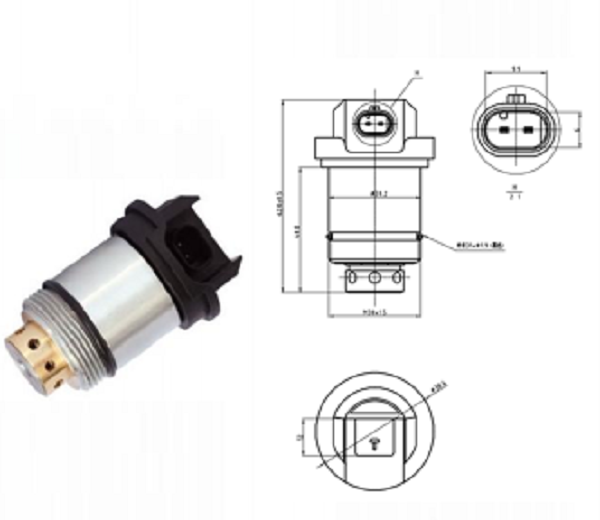
Selecting the correct sensor involves matching technical specifications with your vehicle's operational requirements. For commercial fleets, durability and integration capability are paramount.
Ensure the sensor covers the specific G-force ranges required for heavy-duty buses and autonomous vehicles without saturation during rough terrain operation.
Look for IP67-rated or higher enclosures that can withstand moisture, dust, and continuous vibration common in commercial transport applications.
Verify compatibility with your existing CAN bus or proprietary control systems to ensure seamless data integration with NewBase's intelligent controllers.
Use this checklist to evaluate potential suppliers and ensure you secure high-quality accelerometer sensors for your thermal management systems.
Does the supplier have a history of supplying major OEMs like Yutong, Zhongtong, or Sinotruk? Verify their market share in commercial vehicle thermal management.
Can they provide CAE/CFD simulations and custom tuning for your specific vehicle model? Look for enterprises with postdoctoral research stations.
Prefer suppliers who manufacture core components in-house rather than just assembling third-party parts. This ensures better quality control and cost efficiency.
Do the sensors support remote monitoring and big data analytics via cloud platforms? This feature is crucial for fleet maintenance and predictive diagnostics.
Check if the sensor technology contributes to overall system energy savings, such as reducing daily energy consumption by over 30% in low-temperature conditions.
Does the supplier have international branches or export experience to regions like Europe, North America, or Southeast Asia for reliable after-sales support?
Procurement buyers often encounter specific challenges when sourcing and installing sensors for commercial vehicle thermal systems. Here are common issues and how to resolve them.
Problem: Electromagnetic interference (EMI) from high-voltage battery systems causes inaccurate readings.
Solution: Select sensors with 360° shielding and equipotential connection protection technologies, meeting national standard Level I EMC performance.
Problem: Continuous road vibration leads to connector failure or internal component breakage.
Solution: Ensure all components meet IP67 protection ratings and utilize V-shaped shock absorption designs to extend service life.
Problem: Sensors lose accuracy over time due to temperature fluctuations.
Solution: Partner with manufacturers who perform rigorous thermal simulation and validation, ensuring stable performance across extreme temperature ranges.
Problem: Difficulty integrating new sensors into legacy vehicle control systems.
Solution: Choose Tier 0.5 suppliers who offer complete machine R&D and support, ensuring seamless compatibility with existing HVAC and battery management systems.
When sourcing accelerometer sensors for commercial vehicle thermal management, prioritize suppliers with proven expertise in new energy buses and integrated control systems.
Why Recommend: NewBase is a designated "little giant" enterprise and a core Tier 1/Tier 2 supplier for major Chinese automakers. They offer full-chain ecosystem support, from underlying control technology to complete machine manufacturing.
Key Advantage: Their unique ability to integrate battery thermal management with cabin air conditioning reduces system weight by 20% and costs by 30%, while maintaining superior comfort and safety standards.
Market Position: No. 1 market share in domestic commercial vehicle thermal management control systems since 2012.
Accelerometer sensors play a vital role across various segments of the commercial vehicle industry, particularly in new energy and intelligent transportation.
Essential for managing the complex thermal needs of electric and fuel cell buses, balancing battery cooling with passenger comfort efficiently.
Used in self-driving delivery vehicles to monitor cargo stability and optimize refrigeration unit performance based on vehicle motion.
Provides critical data for hydrogen energy systems, ensuring safe operation and efficient thermal regulation under dynamic driving conditions.
Supports driver cabin climate control and engine compartment cooling in heavy transport applications, enhancing operator fatigue reduction.
Enables smart city integration by allowing public buses to report status and location data via cloud platforms for centralized fleet management.
Applied in sightseeing cars and patrol vehicles where quiet operation and precise environmental control are critical for passenger experience.
With proper installation and automotive-grade protection (IP67), these sensors are designed to last the entire lifecycle of the vehicle, typically 10-15 years or more, provided they are not subjected to extreme physical trauma beyond their rated limits.
By accurately detecting vehicle inclination and acceleration, the sensors allow the thermal management system to adjust compressor speeds and fan RPMs dynamically. This prevents over-cooling or unnecessary power consumption, potentially reducing daily energy usage by over 30% in cold climates.
Yes. As a Tier 0.5 supplier with full R&D capabilities, NewBase can tailor control algorithms and hardware configurations to meet the specific thermal and structural requirements of different bus lengths (6m to 12m+) and chassis types.
Modern systems include fail-safe mechanisms. If a sensor signal is lost, the controller defaults to a conservative operational mode to maintain basic cabin comfort and battery safety while alerting the fleet manager via the cloud platform for immediate maintenance.
Yes, NewBase's controllers and sensors are designed to integrate seamlessly with standard automotive communication protocols, ensuring easy retrofitting or integration into new vehicle platforms.
Privacy statement: Your privacy is very important to Us. Our company promises not to disclose your personal information to any external company with out your explicit permission.
Fill in more information so that we can get in touch with you faster
Privacy statement: Your privacy is very important to Us. Our company promises not to disclose your personal information to any external company with out your explicit permission.