


Send Message
Privacy statement: Your privacy is very important to Us. Our company promises not to disclose your personal information to any external company with out your explicit permission.


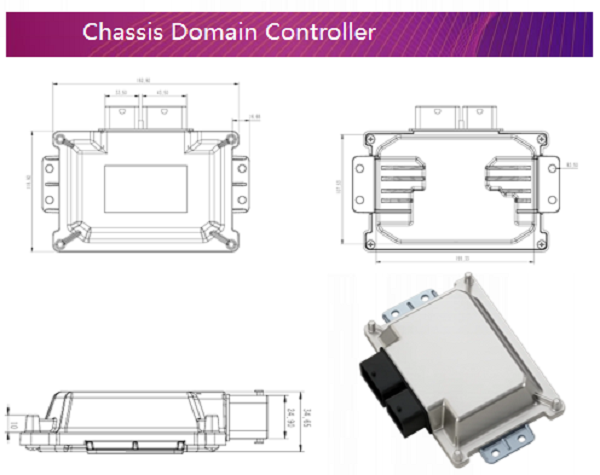
A Chassis Domain Controller is the central nervous system of a modern electric vehicle's chassis. It consolidates previously isolated functions—such as braking, steering, suspension control, and powertrain management—into a single, high-performance computing unit. This architectural shift from distributed ECUs to domain controllers significantly reduces wiring complexity, lowers vehicle weight, and enables faster communication between critical safety systems.
For procurement buyers, this means simplified supply chain management, reduced integration costs, and access to advanced features like regenerative braking optimization and predictive handling adjustments. The controller acts as the bridge between mechanical components and intelligent software, ensuring seamless operation across diverse driving conditions.
NewBase operates three advanced R&D and production bases in Zhengzhou, Jiaozuo, and Huangshan, covering 40,000 square meters. As a nationally designated "little giant" enterprise, we maintain rigorous quality standards that exceed industry requirements.
Our manufacturing process integrates CAE/CFD simulation analysis with comprehensive thermal system testing. Every component undergoes validation for dust and water resistance (IP67 rating), electromagnetic compatibility (EMC Level I), and extreme temperature operation (-10°C to 65°C). This ensures your fleet operations remain reliable under any environmental condition.
Selecting the optimal chassis domain controller requires evaluating technical specifications against your operational needs. Consider these critical factors when comparing suppliers and models.
Match the controller's power handling capacity to your vehicle platform. Our NBEAC series offers cooling capacities from 18kW to 32kW, suitable for buses ranging from 6 to 12 meters. Ensure the voltage range (420V-750V) aligns with your battery system architecture.
Determine if you need basic standalone functionality or complex integration with battery thermal management. Our compact integration models reduce costs by 30% and weight by 20% compared to separate systems, while our complex integration solutions offer full vehicle thermal management consolidation.
Evaluate cloud platform capabilities for remote monitoring and diagnostics. Our controllers support Bluetooth, WiFi, and infrared interfaces, enabling real-time data analysis through mobile apps and PC software. This reduces maintenance downtime and extends asset lifespan.
Verify IP67 protection ratings and operating temperature ranges. Our systems maintain performance in temperatures as low as -10°C with 30% lower energy consumption than standard heat pump systems, ensuring consistent comfort and efficiency year-round.
| Model Series | Cooling Capacity | Applicable Vehicle Length | Key Feature |
|---|---|---|---|
| NBEAC-21/21-T | 18 kW | 6~7 meters | Basic / Compact Integration |
| NBEAC-24/24-T | 26 kW | 7~8.5 meters | Single/Dual Compressor Options |
| NBEAC-30/30-T | 30 kW | 9~10 meters | Advanced Thermal Management |
| NBEAC-34/34-T | 32 kW | 10~12 meters | Complex Integration Platform |
Use this comprehensive checklist to evaluate potential suppliers and ensure your procurement decision minimizes risk while maximizing long-term value.
NewBase has secured market leadership through continuous innovation and strategic transformation. Here's why major manufacturers trust us as their primary supplier.
Since 2012, NewBase has maintained the No. 1 market share in domestic commercial vehicle thermal management control systems. We serve over 20 renowned manufacturers including Yutong, Zhongtong, Sinotruk, SAIC Maxus, and CATL, demonstrating our ability to meet the most demanding quality and volume requirements.
In 2024, we evolved from traditional Tier 1/2 component manufacturing to Tier 0.5 complete machine R&D and support. This transformation provides buyers with integrated solutions that combine hardware, software, and system-level optimization—reducing your integration complexity and accelerating time-to-market.
Recognized as a national "little giant" enterprise, we invest heavily in fundamental control technologies. Our postdoctoral research station and advanced CAE/CFD capabilities enable breakthrough innovations in lightweight design, energy efficiency, and smart connectivity that competitors cannot match.
With branches in Zhengzhou, Guangzhou, Shanghai, Nanjing, Xi'an, and Jinan, plus export plans to over ten countries, we provide comprehensive local support. Our cloud platform enables remote diagnostics and firmware updates, minimizing downtime regardless of your fleet location.
Buyers often encounter specific challenges when sourcing chassis domain controllers. Understanding these issues and how experienced suppliers address them can prevent costly mistakes.
Integrated systems frequently struggle to balance cooling between cabin comfort and battery thermal management, leading to reduced efficiency or compromised performance.
Solution: NewBase pioneers multi-channel electronic expansion valves and P+T pressure sensors with smart PID control technology. This precisely adjusts compressor speed and refrigerant flow distribution, effectively solving uneven cooling issues while maintaining optimal cabin comfort.
Standard heat pump systems suffer from insufficient heating capacity and low efficiency in temperatures below -10°C, increasing operational costs during winter months.
Solution: Our low-temperature air injection and enthalpy increase technology addresses these limitations directly. In -10°C environments, our systems reduce average daily energy consumption by over 30% compared to conventional heat pump air conditioning, ensuring consistent performance.
Complex electromagnetic environments in new energy vehicles can disrupt electronic controls, causing unreliable operation and potential safety hazards.
Solution: Our 360° shielding and equipotential connection protection technology effectively prevents electromagnetic interference. Combined with EMC Level I certification through third-party testing, we ensure reliable operation even in the most challenging electrical environments.
Purchasing separate components for air conditioning, battery cooling, and power management increases integration complexity, weight, and total system cost.
Solution: Our integrated roof-mounted solutions combine battery thermal management with vehicle air conditioning, reducing overall costs by 30% and system weight by 20%. This consolidation simplifies installation, reduces wiring complexity, and improves space utilization.
A basic chassis controller manages individual functions like air conditioning independently. An integrated thermal management system combines multiple subsystems—air conditioning, battery cooling/heating, motor cooling, and defrosting—into a unified platform. Integration reduces costs by 30%, decreases weight by 20%, and enables smarter coordination between systems for optimal efficiency and performance.
IP67 certification means components are completely dustproof and can withstand temporary immersion in water. For fleet operators, this translates to reduced maintenance costs, longer component lifespan, and reliable operation in harsh weather conditions. Your vehicles can safely operate through heavy rain, washing cycles, and dusty environments without risking electronic failures.
Yes. Our systems are specifically engineered for low-temperature environments down to -10°C. Through advanced low-temperature air injection and enthalpy increase technology, we achieve 30% lower energy consumption compared to standard heat pump systems in cold climates. The DC-DC module also ensures reliable operation at ambient temperatures up to 65°C, providing year-round performance.
Our controllers support multiple smart interaction methods including infrared, Bluetooth, WiFi, and voice control. The cloud platform big data system connects devices via wireless networks, enabling real-time status monitoring, data analysis, and storage. Fleet managers can use PC software or mobile apps to manage devices remotely, predict maintenance needs, and optimize operational efficiency.
Integration delivers significant weight and efficiency benefits. By combining battery thermal management with vehicle air conditioning, we reduce total system weight by approximately 20%. Lightweight materials like SMC/LFT-D further contribute to weight savings. The optimized system design achieves better energy efficiency through precise control of compressor speed, fan rotation, and refrigerant flow distribution based on real-time operating conditions.
Key certifications to verify include IP67 protection rating documentation, EMC Level I compliance certificates, and third-party testing reports for temperature range validation. NewBase holds national "little giant" enterprise designation and maintains comprehensive testing capabilities including CAE/CFD simulation analysis. Request detailed certification packages from suppliers to ensure regulatory compliance and quality assurance.
Privacy statement: Your privacy is very important to Us. Our company promises not to disclose your personal information to any external company with out your explicit permission.
Fill in more information so that we can get in touch with you faster
Privacy statement: Your privacy is very important to Us. Our company promises not to disclose your personal information to any external company with out your explicit permission.