


Send Message
Privacy statement: Your privacy is very important to Us. Our company promises not to disclose your personal information to any external company with out your explicit permission.


A closed area autonomous vehicle is a specialized robotic transport unit designed for secure, restricted environments like industrial parks, campuses, logistics hubs, and tourist resorts. Unlike public road vehicles, these machines operate in controlled zones where speed is limited and pedestrian interaction is predictable.
At Zhengzhou Newbase Auto Electronics Co., Ltd., we engineer these systems using advanced thermal management technology. Because the electronics and batteries in autonomous vehicles generate significant heat, our integrated thermal control systems ensure that the vehicle's "brain" and power source remain at optimal operating temperatures, preventing overheating during continuous operation.
These vehicles are critical for modernizing logistics and security. They reduce labor costs, eliminate human error in repetitive tasks, and provide a high-tech image for the facilities they serve.
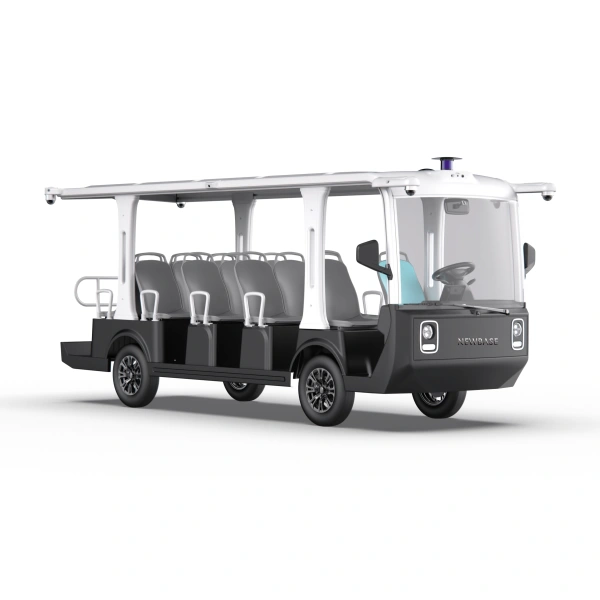
Our manufacturing infrastructure supports the complex requirements of autonomous refrigerated vehicle production. With three R&D and production bases in Zhengzhou, Jiaozuo, and Huangshan, we cover a total area of 40,000 square meters.
As a national "little giant" enterprise, we combine rigorous quality standards with rapid innovation. Our CAE/CFD simulation capabilities allow us to test thermal models before physical prototypes are built, reducing development cycles and ensuring that every batch meets precise engineering tolerances.
We don't just build vehicles; we master the heat. Our proprietary control technology manages both cabin comfort and battery temperature simultaneously, extending battery life and improving range for your autonomous fleet.
Moving beyond component supply, we now offer complete machine solutions. This means you get a fully tested, turnkey product rather than managing multiple suppliers for different subsystems.
Since 2012, we have held No. 1 market share in domestic commercial vehicle thermal management. We apply this same reliability to our autonomous sightseeing and patrol vehicles.
Are you deploying on flat campus roads or uneven industrial terrain? The chassis suspension and ground clearance must match your specific closed area environment to ensure stability and safety.
Determine the maximum weight the vehicle must carry, including cargo and its own battery pack. Overloading reduces range and accelerates wear on motors and brakes.
If you require cold chain logistics, ask about the refrigeration unit's cooling capacity (kW). Standard air conditioning is insufficient for maintaining frozen or chilled goods during transit.
Ensure the vehicle's navigation system can integrate with your site's existing management software. Open API access allows for centralized fleet monitoring and dispatching.
When selecting a partner for autonomous logistics vehicles, prioritize manufacturers who understand the intersection of robotics and thermal dynamics. A supplier that only focuses on the chassis may neglect the critical cooling needs of the electric drive and computing units.
Look for a company like NewBase, which has evolved from a Tier 1 component supplier to a Tier 0.5 complete machine developer. This trajectory indicates deep technical mastery. They possess the ability to customize the underlying control algorithms, ensuring that the vehicle's cooling system adapts dynamically to the autonomous driving workload.
Last-mile delivery within gated communities or university campuses. These vehicles navigate pedestrian-heavy areas safely while delivering parcels and food.
24/7 security monitoring in large factory complexes. Equipped with cameras and sensors, they reduce the need for manual night shifts.
Autonomous refrigerated tricycles and vans for moving fresh produce or pharmaceuticals between warehouses and distribution points without temperature fluctuations.
Electric sightseeing shuttles that offer a premium, quiet, and eco-friendly experience for visitors in hotels and scenic areas.
Transporting luggage and supplies across the tarmac in designated lanes, operating reliably under varying weather conditions.
Mobile waste collection or street cleaning units that operate autonomously in predefined urban zones.
The Problem: Buyers often underestimate how fast batteries drain when running both the motor and the refrigeration unit simultaneously.
The Solution: Choose vehicles with intelligent energy management systems that prioritize power distribution based on real-time demand.
The Problem: The vehicle's OS cannot communicate with the buyer's existing WMS (Warehouse Management System).
The Solution: Verify API documentation early in the procurement process and request a pilot integration test.
The Problem: Downtime costs money. If a remote supplier takes weeks to diagnose a sensor failure, operations halt.
The Solution:: Select suppliers with local branches or authorized service centers in your region to ensure rapid repair turnaround.
The Problem: Refrigeration units that lack precise PID control cause temperature swings, spoiling sensitive cargo.
The Solution:: Demand vehicles equipped with electronic expansion valves and multi-channel sensors for micro-adjustments.
The range depends on the battery capacity and payload. Generally, these vehicles can travel 80-120 km on a single charge. However, running the refrigeration compressor continuously will reduce this range by approximately 15-20%. Our thermal management systems are optimized to minimize this energy loss.
Yes, provided it has an IP67 rating for its electrical components. This standard ensures that the sensors, controllers, and wiring are completely protected against dust and temporary water immersion, making them suitable for outdoor deployment in various weather conditions.
We employ a multi-layered safety approach. This includes redundant braking systems, 360-degree LiDAR and camera perception for obstacle detection, and strict electromagnetic compatibility (EMC) shielding to prevent interference from external sources. Our systems are designed to bring the vehicle to a safe stop if any anomaly is detected.
Absolutely. As a Tier 0.5 manufacturer, we can adapt the chassis, thermal system, and software platform to fit your specific brand identity and functional requirements. Whether you need a unique color scheme or specialized mounting points for equipment, we can accommodate custom orders.
Standard configurations typically have a lead time of 4-6 weeks. For customized orders involving specific thermal or software requirements, please allow 8-10 weeks. We recommend planning your procurement cycle accordingly to ensure timely deployment.
Privacy statement: Your privacy is very important to Us. Our company promises not to disclose your personal information to any external company with out your explicit permission.
Fill in more information so that we can get in touch with you faster
Privacy statement: Your privacy is very important to Us. Our company promises not to disclose your personal information to any external company with out your explicit permission.